Info Our office is closed on Monday 26 October 2026 for Labour Day.
The application portal remains available on this day.
Info Our office is closed on Monday 26 October 2026 for Labour Day.
The application portal remains available on this day.
Before making a substantive application, read this page to learn more about the requirements.
Projects can only use one consenting pathway at a time for approvals. If your project is seeking the same approvals under other related legislation, you are unable to make an application to the Fast-track process without first withdrawing the existing application.
Only an authorised person for a listed project or a referred project may lodge a substantive application in the Fast-track process. Listed projects can be found in Schedule 2 of the Fast-track Approvals Act 2024 (the Act).
Listed projects – Fast-track Approvals Act 2024 – New Zealand Legislation website
A substantive application for a listed project must match the project’s description in Schedule 2 of the Act. To request an amendment to a listed project’s description, contact the Ministry for Cities, Environment, Regions and Transport at referral@fasttrack.govt.nz
Other projects must first apply for referral. This includes projects that applied to be included in the Fast-track Approvals Bill but were not subsequently listed in the Act.
Referral application to use the Fast-track
Check that your project does not involve any ineligible activities (other than activities that may be the subject of a determination under section 23 or 24).
Meaning of ineligible activity – Fast-track Approvals Act 2024 – New Zealand Legislation website
Before applying, you may need to complete preliminary steps. For example, depending on the project activity, lodging:
a pre-request aquaculture agreement with the relevant chief executive
a land exchange application with the Director-General of Conservation
More detail: Land exchange applications
mining permit information with the relevant chief executive.
If you intend to apply for a resource consent, your application must identify any existing resource consent for the same activity using some or all of the same natural resource. Before lodging your application, you must notify the relevant regional council about the resource consent you are applying for. Include their response in your application. Be prepared to provide more detailed information if requested by the council, for example relevant technical reports or assessment of environmental effects.
Prepare the information you’ll need for your application before you begin working in the application portal. If you’re unsure about any procedural requirements, check with the Fast-track team. Once you submit your application the team has a limited time to assess it for completeness. If your application is returned and you submit a new one later, you will incur additional cost.
The Minister for Infrastructure can determine that a project is a priority project, either on their own initiative or if the applicant requests. This request must be made:
after paying any outstanding fees or costs
before making the substantive application.
Applying for priority for a Fast-track substantive application
The Ministry for Cities, Environment, Regions and Transport handles these requests. To apply, contact the Ministry at referral@fasttrack.govt.nz
The applicant for a listed project that is planned to proceed in stages can apply to the Minister for Infrastructure for a determination on whether they can lodge a substantive application for a specified stage of the project.
To apply, contact the Ministry for Cities, Environment, Regions and Transport at referral@fasttrack.govt.nz
The panel convener and associate panel conveners issued a practice and procedure guidance note. It provides practical guidance to all participants in the Fast-track substantive process, in particular to the panels appointed by the panel conveners.
Practice and procedure guidance note (PDF, 303KB)
The panel convener and associate panel conveners also issued a Minute providing guidance to panels regarding suspensions under the Fast-Track Approvals Act 2024, in particular applicant-requested suspensions under section 64.
Minute from Panel Convener: Suspensions under the Fast-Track Approvals Act 2024 (PDF, 104KB)
All substantive applications must be submitted using the digital form provided in the Fast-track application portal. The document below provides guidance on the information required in your application.
Substantive application form guidance – effective 31 March 2026 (PDF, 663 KB)
The Fast-track team will give you access to the application portal during the pre-application process.
Fast-track application portal user guide – substantive applications (PDF, 2.0 MB)
If you become aware of an issue with your application after submitting it in the portal, for example you’ve omitted a document in error, please contact the Fast-track team immediately.
You must pay a levy and an application fee when you apply. When you submit your application in the Fast-track portal, you will be sent an invoice for the levy and application fee. The application fee and levy are fixed amounts depending on the type of application. Your application isn’t considered lodged until the levy and fee are paid.
More detail: Fees, charges and cost recovery
Application documents are published on this website as soon as possible after checks are made. These checks include any redactions requested by the applicant or required by us under the Fast-track Approvals Act 2024 and Privacy Act 2020.

Once a substantive application is lodged, the Fast-track team has 5 working days to provide the application to the panel convener and 15 working days to assess whether the application is complete and in scope. These two steps happen in parallel. The applicant will be notified of the outcome of this assessment.
After a decision is made on completeness and scope the Fast-track team has 10 working days to make a decision on whether there are competing applications or existing resource consents for the same activity. If there are none, the Fast-track team will notify the panel convener that a panel can be set up.
If an application is assessed as incomplete, or we determine there are existing resource consents for the same activity, the application is returned to the applicant. The applicant can choose to prepare and lodge a new substantive application. Any new application could be subject to additional costs.
Expert consenting panels are independent decision-making bodies set up for each Fast-track project. The panel convener appoints a panel of up to four members for each project (or more in some circumstances), generally chaired by a suitably qualified lawyer or resource management planner. Panel members must also include a person nominated by the relevant local authorities. Once all panel members have been appointed, the panel must begin working on the application within 5 working days.
Panels have a range of functions and powers as part of considering applications and notices of requirement and making decisions. They can hold hearings, request reports or advice, and identify the appropriate people to invite comments from.
The Fast-track team provides procedural advice and secretariat support to panels. We are not involved in the decision-making.
More detail: Expert panels
The panel must invite written comments from some people or groups listed in the Act. The Act does not allow panels to give full public notification or limited notification for comments.
More detail: Comments
A hearing is not required, but the panel must consider whether to hold one. If a hearing is held, the panel may hear from:
the applicant
people commissioned to write a report on the application
any person or group that provided comments after being invited as described in the Act.
Hearing of panel – Fast-track Approvals Act 2024 – New Zealand Legislation website
The processing of the application can be suspended and later resumed, for reasons defined in the Act.
The applicant can apply to have their application reduced in scope. The panel can allow this or ask the Minister to make a determination on whether the project still has significant regional or national benefits in its proposed reduced form. The statutory timeframe for application processing is paused during this time.
Reducing scope of substantive application – Fast-track Approvals Act 2024 – New Zealand Legislation
The panel makes a decision based on the matters described in the Act and the information from the application and the assessment process.
This includes considering any relevant Government Policy Statement and, for a referred project, the Minister’s reasons for accepting the project’s referral application.
The panel can set conditions on an approval, for example requiring measures to manage the impact of the project.
If the panel intends to grant an approval with conditions, they must first provide the draft conditions for comment to:
the applicant
relevant local authorities and administering agencies
certain Ministers
any persons or groups that provided comments in response to an invitation by the panel.
If the panel intends to decline an approval, they must first provide their draft decision to the applicant and other parties specified in the Act.
The applicant can:
propose conditions or modify the approvals sought to address the panel's reasons for decline
withdraw parts of the application.
After considering the applicant's proposal and any Ministerial input, the panel may:
uphold the draft decline, resulting in a final decline
approve the revised proposal, provided it is within scope of the substantive application.
As well as the draft decision, the Act specifies other requirements for making a decision. These include the opportunity for panels to transfer certain decisions to the appropriate Minister, or for the appropriate Minister to ‘call in’ the decision taking into account the panel’s advice.
Draft decisions on approvals – Fast-track Approvals Act 2024 – New Zealand Legislation website
The panel must issue its decision within the timeframe set by the panel convener. This must be within 90 days of the date comments were first invited by the panel, unless the applicant agrees otherwise in writing. If the panel convener has not set a timeframe, the panel must issue its decision within 30 working days of the deadline for receiving comments from invited parties.
When the decision is made, the applicant and other stakeholders are notified as defined in the Act. The decision is also published on this website. Decisions on two or more approvals in the same application may be issued at the same time or at different times, at the discretion of the panel.
A panel’s decision to grant or decline an approval may be appealed to the High Court. Appeals can be against the whole or a part of the decision, but only a on question of law. The following people can appeal:
the applicant
any relevant local authority
the Attorney-General
any person or group specified in the Act that provided comments in response to an invitation from the panel
any other person who provided comments before 17 December 2025 in response to an invitation from the panel.
Appeals and judicial review – Fast-track Approvals Act 2024 – New Zealand Legislation website
The Fast-track team and the Environmental Protection Authority are not decision-makers and should not be named as a respondent. The address for service is general.counsel@epa.govt.nz
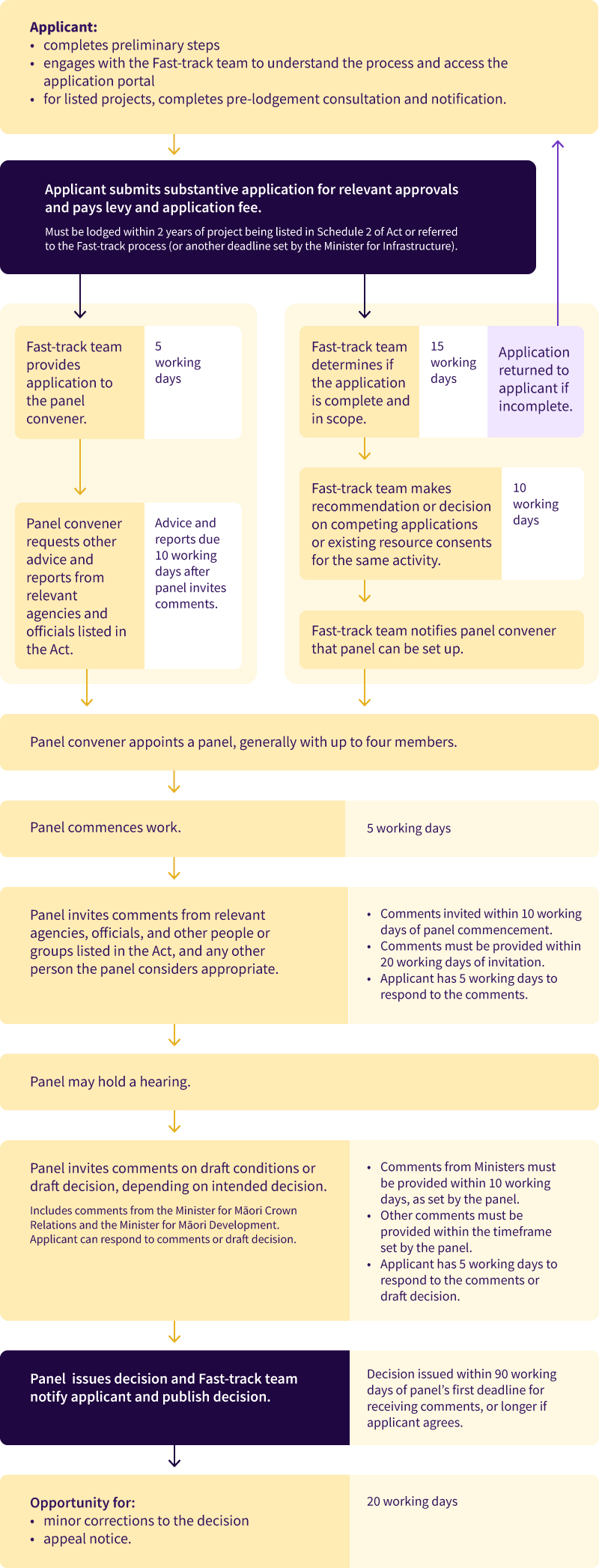
Diagram showing key steps and timings in the Fast-track substantive application process